
Reservoir Park dates to 1845 when city leaders put aside an undeveloped parcel of land containing the city’s highest point, an excellent vantage point for viewing the Capitol and the river with the Blue Mountains as a backdrop. There are three reservoirs in the park that date from 1872: an underground thirty-million-gallon reservoir and two six million gallon above-ground reservoirs which gravity feed water to Harrisburg’s residents.
The Greenbelt passes right through the park and bicyclists riding from the Cameron Parkway may be surprised to learn that the climb up to the city’s highest point is less of a challenge than pedaling up Parkway Boulevard into the park. Compared to the Parkway, it is a relatively easy climb with spectacular views.
The park was designed by landscape architect Warren H. Manning, who worked with Frederick Law Olmstead on many of America’s most famous and treasured landscapes (like the Biltmore Estate and New York City’s Central Park). Manning was a force behind Harrisburg’s City Beautiful movement. He is also responsible for the design of Harrisburg’s most exclusive neighborhood (just across Market Street from Reservoir Park), Bellevue Park, Pennsylvania’s first fully-planned residential community, as well as Wildwood Park and Italian Lake.
Reservoir Park, the city’s largest, occupies 85 acres and includes a bandshell that during the summer offers musical programs and movies. The bandshell was built during the Depression by the Works Projects Administration (WPA). The WPA, like the Civilian Conservation Corps (CCC), were Depression-era “back-to-work” programs created by President Franklin D. Roosevelt.
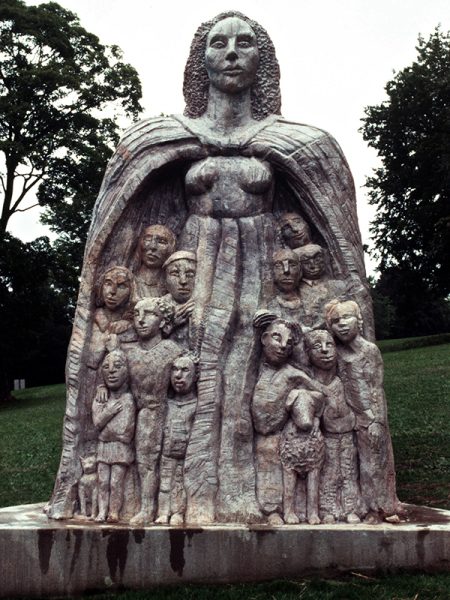
Bicyclist entering the park on Parkway Boulevard ride by a major work of art on their left, a large concrete sculpture paying homage to women called Mother Park. Created by Harrisburg native Deborah Masters, the sculpture was dedicated on September 23, 1993. The full-length female figure wears a long gown and a long cape over her shoulders. Within the shelter of the cape are a number of men, women, and children, six figures on each side. One of the children on the right side hugs a dog and a cat appears on the left side.
In addition to playgrounds for children, a pavilion you can rent for large picnics, and several buildings where art courses are offered, the park’s gem is the National Civil War Museum which opened in 2001 and has welcomed more than a million visitors from all 50 states and around the world. Next to the building is the Walk of Valor, a ribbon of red bricks that bear the names of Civil War veterans honored by their descendants.
An article by Bill Cologie.
Did you enjoy this article? Consider donating to our Buckle the Belt fundraiser.
Along the Greenbelt is produced by the Capital Area Greenbelt Association in cooperation with The Historical Society of Dauphin County.