
Growing up in Wilkes-Barre in the 1950s in a home heated by coal, with a father who worked in a colliery (until he graduated from college on the GI Bill), one was aware of the different grades of coal. The smallest was Rice, which would fall through a ¼ inch mesh screen, then Buckwheat, Pea, Chestnut, which would fall through a 1 ¼ inch screen, and Stove coal which could pass through a 1 ¾ inch screen.
Wilkes-Barre was the heart of Anthracite (hard) coal mining in Pennsylvania, though that hard coal could be found as far south as northern Dauphin County. In the early days, homes were heated with Chestnut, coal stoves found in many kitchens in the early 20th century burned Stove coal, and many industries used only the larger grades of coal with pieces ranging from 2 ¼” to 4” thick.
Most coal companies in eastern Pennsylvania washed their coal with river water or in streams that flowed into the Susquehanna. Since few of their customers were using the smaller grades, there was no effort made to keep that coal from washing into the river. Harrisburg’s Dock Street Dam, built in 1913, kept much of that smaller coal from flowing further south.
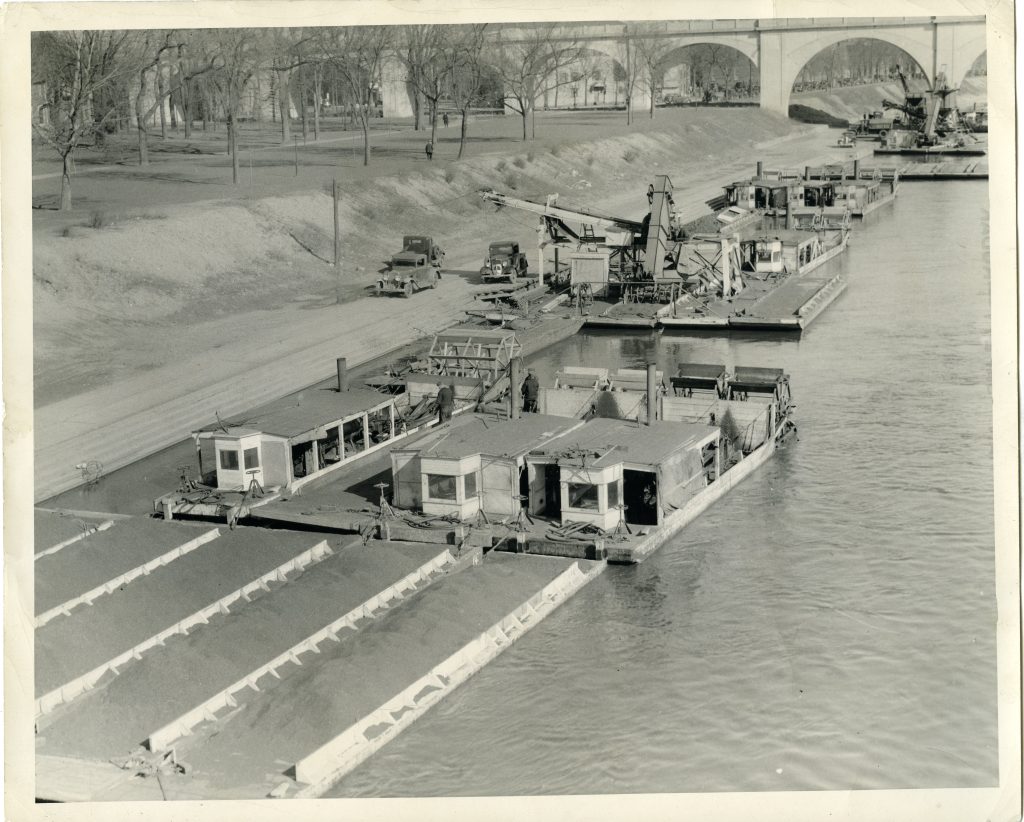
The generators of electricity, who built coal-fired plants in the early part of the 20th century, and steel mills burned the finer grades of coal, thus spawning an industry to dredge coal off the river bottom. For a stretch of 80 miles, from Shickshinny in southern Luzerne County to where the river flowed by the state capitol building, 20 companies operated fleets totaling a couple of hundred boats, staffed by some 300 men who would dredge the river bottom between March and Thanksgiving, harvesting millions of tons of coal.
Harrisburg’s Charles Downey had a fleet that operated from the Shipoke area (then known as Lochiel) that included 55 coal barges, five paddlewheel steamboats, and 12 dredges. The last boat of the Downey fleet served as one of the Millersburg ferries, but was retired around the end of the 20th century. The dredging industry flourished from the 1920s until the passage of a state clean water act in 1946 led to its demise in the 1950s. Downey lived at Cameron and Magnolia streets and two garages on that property are now used to house some of the Capital Area Greenbelt Association’s trail maintenance equipment.
An article by Bill Cologie.
Did you enjoy this article? Consider donating to our Buckle the Belt fundraiser.
Along the Greenbelt is produced by the Capital Area Greenbelt Association in cooperation with The Historical Society of Dauphin County.