
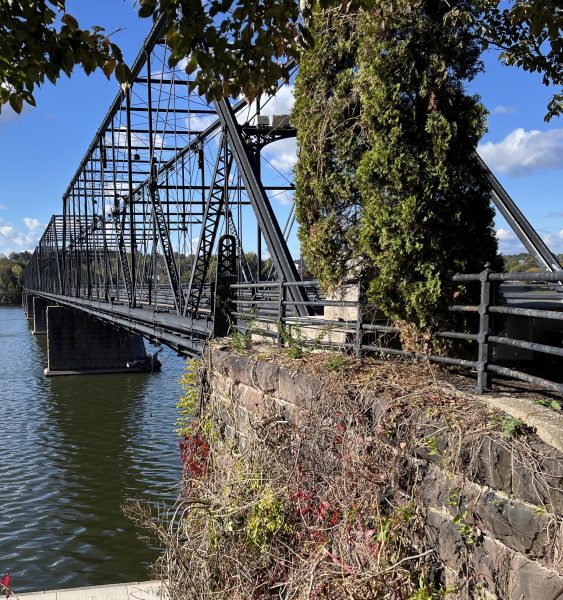
The Harris Ferry was the primary means of crossing the Susquehanna River in central Pennsylvania from 1733 until a wooden bridge, known as the Camelback Bridge, was completed in 1817. At that time, most major roads were toll roads, as was this bridge. As the city grew, so did the use of the bridge. But over time, people became dissatisfied with the bridge’s monopoly status and high tolls. In fact, in winter, people would risk crossing on the ice rather than pay the Camelback’s toll. A January 1881 newspaper article reported the ice to be 16 inches thick and that two roads—both safe for horses and wagons—had been created across the ice, one crossing to West Fairview and the other to Wormleysburg.
In the 1880s, the high tolls were seen as a detriment to travel and commerce. West shore farmers disliked paying the toll to bring their crops to market. Business people, with commerce on both sides of the river, were also aggrieved. And in 1889, the People’s Bridge Company was incorporated to build a new bridge.
Owners of the Camelback Bridge, did everything in their power to block competition. They even rejected an offer by the upstart company to buy their bridge, so People’s Bridge Company founder Elias Zollinger Wallover raised the capital to build a new bridge.
Wallover hired the Phoenix Bridge Company, a subsidiary of the Phoenix Iron Works of Phoenixville, PA to build it. The Iron Works built cannons and manufactured cannon balls and rifles for the Union Army. The company’s iron was in the original rails of the Pennsylvania Railroad, the building of the Eiffel Tower, and in more than 4200 bridges worldwide.
In 1862 the iron company invented the Phoenix Column, a hollow cylinder made of four, six, or eight wrought iron segments riveted together, resulting in a column much lighter and stronger than the solid wrought iron columns used at the time. Phoenix Columns were used in the construction of the Walnut Street Bridge and also made possible the building of massive structures, including early skyscrapers and high-stress load bearing bridges.
The Walnut Street Bridge, known as the “People’s Bridge” because of its lower tolls, was completed in 1890. Both the Market Street Bridge, which replaced the Camelback Bridge, and the Walnut Street Bridge continued to charge tolls well into the 1950s. Permanently closed to vehicular traffic after the damage wrought by Hurricane Agnes in 1972, the bridge escaped demolition through the structure’s listing in the National Register of Historic Places. Post flood it has been a pedestrian and bicycle span. An ice storm in 1996 took out three sections of the western span, while the eastern span remained intact and was totally restored in 1997. Until that 1996 storm, it was the oldest surviving bridge spanning the Susquehanna.
In 1999, 25 years after Hurricane Agnes, then Harrisburg Mayor Stephen R. Reed dedicated Swenson Plaza, the entry to the bridge’s eastern span at Front & Walnut Streets.
An article by Bill Cologie.
Along the Greenbelt is produced by the Capital Area Greenbelt Association in cooperation with The Historical Society of Dauphin County.