
Five Senses Garden
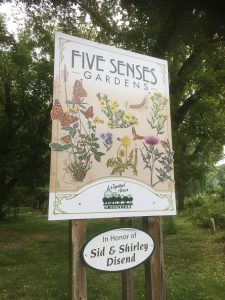
I often see people on the Greenbelt with earbuds and can’t help but think they’re missing the rustling of leaves, the calls of birds, the babbling of streams, and, most importantly for cyclists, the sounds of the traffic around them. While a short walk on any section of the Greenbelt provides beautiful views of natural and historic sites, there’s one section of the Greenbelt designed to engage all your senses through its rich array of native plants and sensory experiences.
The Five Senses Garden, located where the Greenbelt crosses PA Route 441, allows you to hear all the things mentioned above and more. The vegetation provides a lush palette of shapes and colors, but there are works of art here as well, in addition to insects, birds, and animals native to this habitat. You can touch the bark of trees and experience the texture of flowers, leaves and seedpods. You can smell flowers in bloom and the fragrance of shrubs and herbs. And, as parts of many plants are edible or used as herbal remedies, reflect on your last taste of mint tea or any fresh fruit you may have enjoyed as you walk this garden’s well-maintained paths.
Wandering through the site you’ll find gardens dedicated to each sense.
• The Sight Garden features plants distinctive in their sizes shapes, and colors.
• The Sound Garden, along Spring Creek, lets you hear the babbling of the brook as it flows over stones, the buzzing of bees, the chirping of birds, as well as the sound of the wind rustling through the tall ornamental grasses.
• The Touch Garden enables you to experience the rough bark of trees, the fuzziness of plants like Lambs Ears, soft pussy willows, sandpapery hops, and the prickly pear cactus.
• The Taste Garden is filled with herbs and fruits when in season.
• The Smell Garden is full of aromatic plants ranging from sweet smelling phlox and Joe Pye weed, spicy spicebush, minty mountain mint, and more.
In all, there are about 25 different garden areas all planted with various Pennsylvania native pollinator plants, trees, and shrubs, most of which are host plants to support native lepidoptera (butterflies, moths, and skippers) as well as bees and other pollinators. The native insects feed the birds and other animals up the food chain. You’ll also find a variety of groundcovers surrounding many of the mature trees and benches on which to sit or have a special photograph taken.
This sensory experience is made possible by a small army of dedicated groundskeepers headed by Capital Area Greenbelt Association volunteer and Master Gardener Cindy Hogeman. They labor in the shadow of Shirley and Sid Disend who first conceived the garden in 1995 on land that in the early 1990s served as a dump. After removing countless tires and other debris from the site, with the help of landscape architect Craig Bachik of Ed Black and Associates, the garden began to take shape.
Anyone interested in volunteering to help maintain this beautiful garden or donating surplus native plants should contact Cindy Hogeman at chogeman@gmail.com.
An article by Bill Cologie.
Did you enjoy this article? Consider donating to our Buckle the Belt fundraiser.
Along the Greenbelt is produced by the Capital Area Greenbelt Association in cooperation with The Historical Society of Dauphin County.